Kirsten Dunst captivates in Alex Garland’s visceral, discomforting and soul-shatteringly pointless political thriller
Watching Alex Garland’s mesmerizing “Civil War” brings to mind a subtle but powerful premise from a very different movie: that war, by its very definition, is immoral. In 2013’s “Star Trek: Into Darkness,” Spock and James Kirk are arguing over the proper course of action following a terrorist attack, debating regulations and morality in the face of a possible war. The thing is, in “Civil War,” there is no debate — war is already raging — and we’re well past the point of morality. All that’s left is to see the horrifying ordeal through to its conclusion — something “Civil War” does in depressingly fantastic fashion.
The United States is riven: A fascist third-term president (Nick Offerman) is heading a government clashing against secessionist states, with California and Texas’ odd-couple Western Forces at the fore. (Something about the group’s two-star America-style flag is … unnerving.) The scene is a little “Mad Max” meets “The Last of Us” — deafening chaos and bedlam mixed with eerily quiet scenes of devastation — and war photojournalist Lee (Kirsten Dunst) and her colleague Joel (Wagner Moura) are documenting the horror of it all as they trek to Washington, D.C., to interview the president.
It would paint a heroic portrait of journalists in wartime (particularly as they face being shot on sight by U.S. forces), but “Civil War” isn’t that kind — and for Dunst’s hardened, cynical Lee, it doesn’t really matter anyway. Her work has left its scars, her trauma never far from the surface. Even her longtime mentor Sammy (Stephen McKinley Henderson) worries.
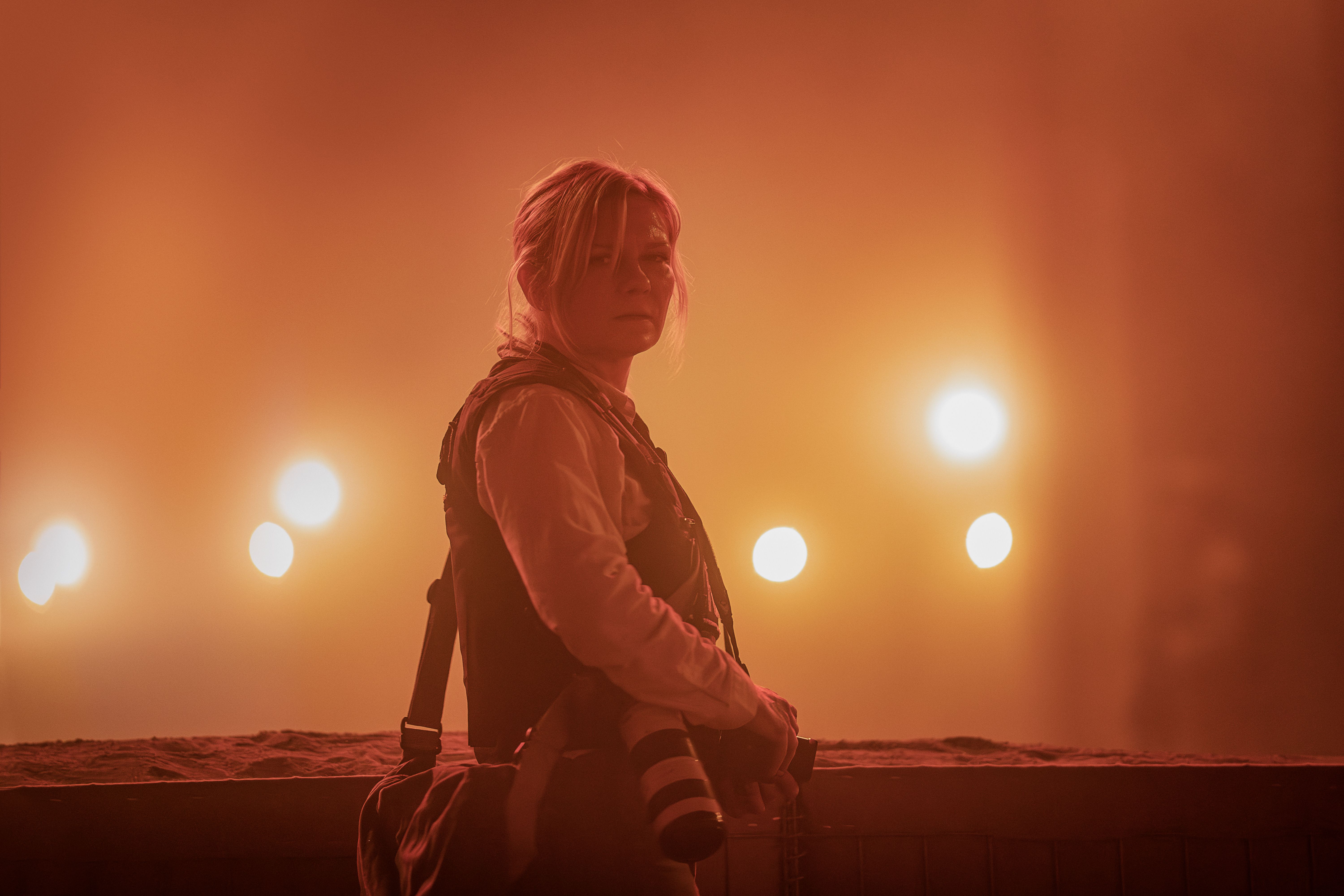
So it’s a less-than-subtle foil when young, budding photographer Jessie (Cailee Spaeny) wiggles her way into the same D.C.-bound car as Lee. The newcomer’s naïveté is obvious, her need to prove herself to Lee dangerously earnest. They’re mirror opposites with the same endgame.
It’s under the din of gunfire and dying screams — “Civil War” has moments of wonderful stillness, captured in haunting photographs, but its default is loud — where small moments of humanity develop. Sammy shares his knowledge, Joel is shameless in the best kind of way, and Lee softens ever so slowly while working with Jessie. The trauma is still there, but it’s not so overwhelming. It feels almost like family. Almost like healing.
It’s hard to heal, though, when death lurks at every gas station (apparently Canadian dollars are more future-proof than American ones), on every stretch of road, in every seemingly idyllic small town. As the distance to D.C. decreases, the danger inversely increases — the gunfire louder, the blood brighter, the depravity … well, let’s just say it gets depraved.
In the end, “Civil War,” as horrifying as it is, doesn’t have much to say. Maybe it’s an ode to the journalists who document war as it unfolds. Maybe it’s about the family we make. Maybe, amid the rockets’ red glare and the bombs bursting in air, it’s not saying anything at all. Maybe it’s not meant to; bullets are faster than words, after all.
Four “Only Canadian dollars, please” stars out of five.
 Silver Screening Reviews